01
Inspired by nature
Natural electromagnetic resonances occur between Earth and the ionosphere. The fundamental resonance typically peaks at around 7.83 Hz.
Our planet has a fascinating electromagnetic resonant cavity. This natural phenomenon inspired us to provide a steady, electronically generated frequency rhythm.
An idea inspired by nature. Created using modern technology. Powered simply by USB.
The idea explained ↓Explore the PHYbio Stick in our shop ↗
We live in a world full of technology. At the same time, natural electromagnetic phenomena existed long before computers and smartphones. One of these is the Schumann resonances. They inspired our idea.
Natural electromagnetic resonances occur between Earth and the ionosphere. The fundamental resonance typically peaks at around 7.83 Hz.
The PHYbio Stick produces two separate, regular electrical frequency signals: 7.53 Hz and 15.06 Hz. Both frequencies have been verified by measurement.
This compact device only needs a suitable 5 V USB port. No app, no settings, no additional software.
The Schumann resonances, sometimes referred to as the “Schumann frequency”, are generated by lightning activity worldwide in the resonant cavity between Earth’s conductive surface and the lower ionosphere.
There is not just one fixed “Schumann frequency”. Instead, there is a spectrum with several broad resonance peaks. The familiar 7.83 Hz value approximately describes the peak of the fundamental resonance, not an isolated, unchanging frequency.
Lightning excites extremely low-frequency electromagnetic oscillations in this cavity. Their wavelengths are comparable to Earth’s circumference. The fundamental mode can be understood as a large-scale standing wave pattern in the thin region between Earth and the ionosphere.
The first resonance typically peaks at around 7.83 Hz. Further resonance regions occur near 14.3, 20.8 and 27.3 Hz. The positions and strengths of these peaks can vary under natural conditions.
The PHYbio Stick was developed with the fundamental resonance frequency range in mind. Its technical near field should not be equated with natural Schumann fields.
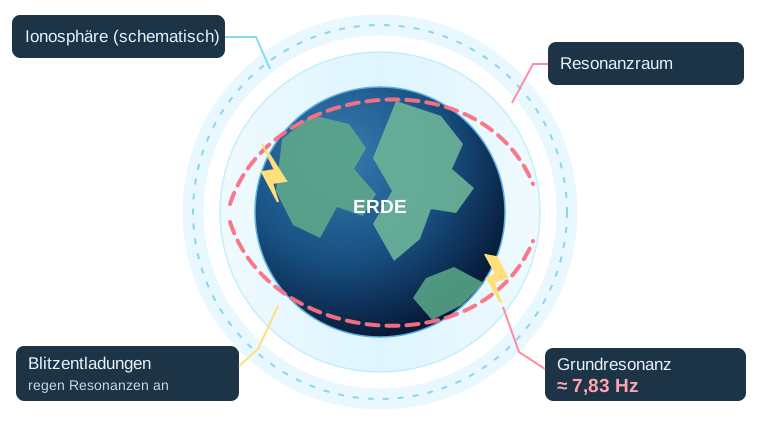
A natural electromagnetic resonant cavity exists between Earth’s surface and the ionosphere. Lightning activity worldwide excites the Schumann resonances. Because this cavity is so large, very low frequencies can resonate.
Schematic illustration of Schumann resonances. Dimensions and wave patterns are not to scale.
Why does a clarinet sound different from a flute when both play the same note? This simple question leads directly to the difference between sine and square waves.
Nature does not consist only of sine waves. It also contains brief impulses, regular rhythms and complex oscillations.
A clarinet and a flute can play the same fundamental note, yet we recognise their different sounds. That is because higher-frequency components accompany the fundamental: overtones.
That is the key: The fundamental note can remain the same even when the overall signal shape differs.
A smooth wave containing a single frequency – comparable to a pure tone.
A regular alternation between two levels. It has a clear fundamental rhythm and also contains harmonics.
Why does the PHYbio Stick use this signal shape? Its electronic controller can directly generate the two fundamental rhythms of 7,53 Hz and 15,06 Hz digitally. This is a simple and transparent technical solution.
A natural example: lightning produces a brief electromagnetic impulse that excites, among other phenomena, the Schumann resonances. However, a lightning impulse is not a periodic square wave. The PHYbio Stick does not reproduce natural Schumann resonances.
The important point: Square waves are not inherently better or worse than sine waves. They are different signal shapes. No biological effect can be inferred from the choice of waveform.
An ideal symmetric square wave with a 50% duty cycle contains odd harmonics in addition to its fundamental frequency. For 7.53 Hz, the first two higher components occur at 22.59 Hz and 37.65 Hz. The amplitudes of successive odd harmonics decrease.
As with the clarinet, there is a fundamental and additional harmonics. Mathematically, an ideal square wave can be expressed as the sum of a fundamental sine wave and odd harmonics. For the 7.53 Hz signal, the coloured curves show these components and their sum.
Illustration of the Fourier decomposition of an ideal symmetric square wave with a 7.53 Hz fundamental. Sine components are colour-coded for clarity. Not a field measurement.
What do Schumann resonances and the PHYbio Stick have in common? Both can be described in terms of frequency components. On the left are broad resonance regions; on the right, narrow lines for the fundamental frequencies and their harmonics.
The broad peaks indicate frequency regions where natural resonances are particularly prominent. They shift slightly in this illustration. These are not live measurements.
The taller lines represent the two fundamental frequencies, 7.53 and 15.06 Hz. Smaller lines represent calculated harmonics of ideal square waves. This is not a measurement of the near field.
How to read the charts: the horizontal axis shows frequency in hertz (Hz). The height illustrates the relative strength of different components. The vertical scales of the two charts are not directly comparable. Both plots are schematic.
Compact, easy to use and designed around two deliberately selected frequencies.
A quartz-controlled microcontroller produces two electrical square-wave signals at a 1:2 frequency ratio. The circuit is designed for these two outputs. The signal illustrations are schematic.
The output frequencies were verified using an oscilloscope and frequency counter : 7,53 Hz und 15,06 Hz. The frequency values are derived from the circuit design and confirmed by measurement. The second frequency is twice the first.
Could a steady rhythm provide a point of reference?
Our environment contains many natural rhythms. Some are very regular, while others change with their surroundings. Schumann resonances also vary naturally; these variations are not in themselves considered harmful.
The PHYbio Stick takes a different technical approach: its quartz-controlled microcontroller generates two electrical signals using a fixed electronic timing reference.
What do we mean by an “anchor”? Here, an anchor is a metaphor for a fixed timing reference. While environmental properties change, an electronic target rhythm remains defined. This led us to ask: Could such an electrical rhythm, under certain conditions, provide an additional timing reference for biological processes?
The fundamental Schumann resonance typically peaks around 7.83 Hz. A slightly lower fundamental frequency was deliberately selected for the PHYbio Stick: 7.53 Hz, or 0.30 Hz below that reference. This frequency was verified with an oscilloscope and frequency counter.
The further question behind our anchor hypothesis: Could an electronically defined rhythm, slightly offset from the typical Schumann reference, provide a timing reference for biological processes under certain conditions? It has not been demonstrated that such perception or coupling is possible.
This is not an established property of biological systems. There is no evidence that they detect or synchronise to the Stick’s weak electrical signals, or that 7.53 Hz is more suitable than 7.83 Hz or other frequencies. Natural Schumann resonances also have a broad spectrum; these values are not separate, isolated resonance regions.
A regular signal alone does not mean a biological system can detect or follow it. The strength and spatial distribution of the electric near fields are not quantified here. Whether biologically relevant coupling is possible is unknown.
The anchor hypothesis is an idea, not a demonstrated effect. Synchronisation of biological rhythms or health effects has not been demonstrated. The Stick does not alter Schumann resonances and neither shields nor neutralises electromagnetic fields.
Established physics: Schumann resonances are natural electromagnetic resonances with changing properties.
Quartz-controlled microcontroller signal generation with two outputs at 7.53 Hz and 15.06 Hz. Both frequencies were checked with an oscilloscope and frequency counter.
Open question: Whether an extremely weak electrical near field could be detected by biological processes and used as a timing reference.
Deliberate frequency selection: The 7.53 Hz fundamental is below the typical Schumann reference of approximately 7.83 Hz. No potential advantage of this difference for biological synchronisation has been demonstrated.
A blinded comparison with an outwardly identical inactive device would be one possible study design. No such evidence is available.
The frequencies were part of the concept from the beginning. The PHYbio Stick was originally developed and offered as the USB Anti-Smog-Stick. Today’s name, PHYbio Stick, describes the product without implying electromagnetic protection.
The technical concept was not retroactively derived from user reports.
The current name PHYbio Stick is not intended to suggest protection from electromagnetic fields.
The former name “USB Anti-Smog-Stick” does not mean the device shields, neutralises or measurably reduces electromagnetic fields.
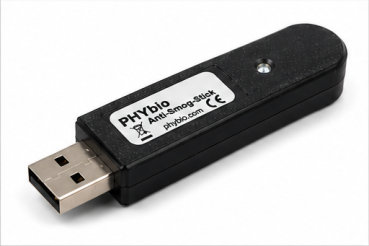
A quartz-controlled microcontroller generates two electrical signals at 7.53 Hz and 15.06 Hz (verified using an oscilloscope and frequency counter). These drive two coil elements connected at one end only, which act primarily as capacitive electrodes at these low frequencies.
A quartz oscillator provides the microcontroller with the timing reference for two electrical output signals. 7,53 Hz und 15,06 Hz were measured with an oscilloscope and frequency counter . Quartz control enables reproducible timing generation.
Two short videos illustrate signal generation and electrical coupling. Our coloured Fourier animation above shows how the harmonic components of a square wave combine.
Two animations illustrate the signals and capacitive coupling.
Newly created schematic animation. Not a recording or validated field simulation.
Newly created schematic animation. Not a recording or validated field simulation.
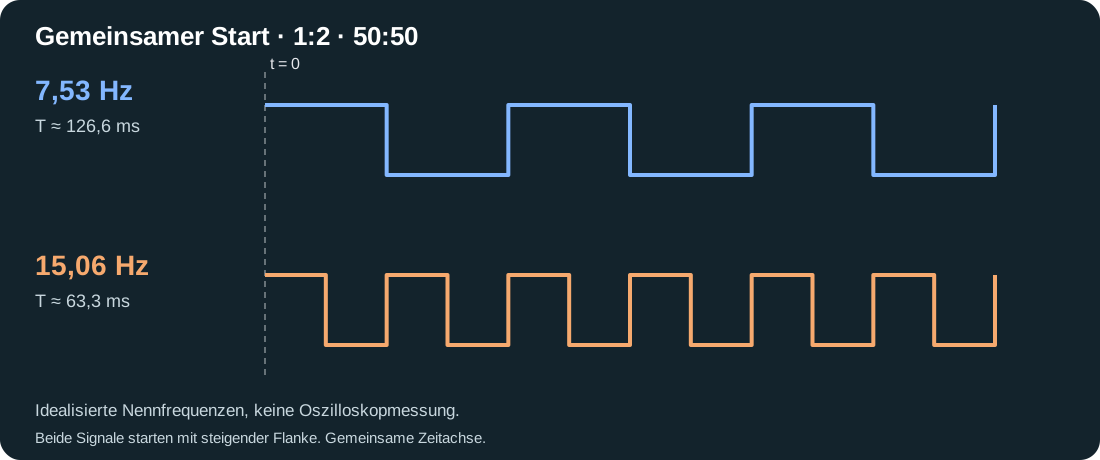
The two output frequencies, 7.53 Hz and 15.06 Hz, were checked with an oscilloscope and frequency counter. A quartz-controlled microcontroller generates the signals. The second frequency is twice the first. The open-ended coil elements act primarily as capacitive electrodes.
The PHYbio Stick is powered from a suitable 5 V USB port, such as a power adapter, computer or power bank. The indicator LED lights briefly on startup and then flashes periodically to indicate operation.
Ease of use does not establish any biological or health effect.
| Product | PHYbio Stick (previously USB Anti-Smog-Stick) |
| Power supply | 5 V via USB |
| Frequency generation | Quartz-controlled microcontroller |
| Signals (measured) | 7.53 Hz / 15.06 Hz – checked with oscilloscope and frequency counter |
| Waveform | Square wave by circuit design. Duty cycle and simultaneous start are not specified here. |
| Weight | approx. 15 g |
| Housing | PETG, 3D-printed |
| Operating temperature | 0 to 40 °C |
| Development | Liechtenstein |
| Production | Germany |
| Housing production | 3D printing (additive manufacturing) |
Note about power banks: Some power banks automatically switch off when current consumption is very low. Check whether the indicator LED continues to show operation. A USB power adapter may be a more reliable supply.
The PHYbio Stick combines quartz-controlled electronics with a specially designed 3D-printed housing. The housing is made of PETG, a robust plastic used in technical applications.
3D printing allows the housing design to be refined and adjusted without expensive injection-moulding tools.
No. It is an open hypothesis. There is no evidence that the PHYbio Stick signals influence biological rhythms or improve well-being.
The measured 7.53 Hz fundamental is 0.30 Hz below the typical Schumann reference near 7.83 Hz. Natural resonances vary and have finite spectral widths. This does not demonstrate a biological effect. The second output, 15.06 Hz, is twice the first, not the second Schumann resonance.
The former name could imply protection from electromagnetic fields. We therefore use the more neutral name PHYbio Stick. The device neither shields nor neutralises such fields.
The output frequencies of 7.53 Hz and 15.06 Hz were checked with an oscilloscope and frequency counter. A quartz-controlled microcontroller generates the signals. The printed instructions use rounded values of 7.5 and 15 Hz. Duty cycle, phase, field strength and long-term stability are not presented as separately measured specifications here.
Nature includes not only sine waves but many different rhythms and impulses. A square wave has a regular fundamental rhythm plus harmonics, much like a musical instrument produces overtones in addition to its fundamental note. The PHYbio Stick uses square waves because they can be generated directly in digital electronics. This does not reproduce natural Schumann resonances. No biological effect has been demonstrated.
The PHYbio Stick is an electronic device that generates two defined electrical output signals. The underlying anchor hypothesis remains scientifically unconfirmed. The device is not intended to diagnose, treat, relieve or prevent disease. No biological or health effect is claimed.
Schematic illustrations, some created with AI assistance. They are not measurements or validated field simulations.